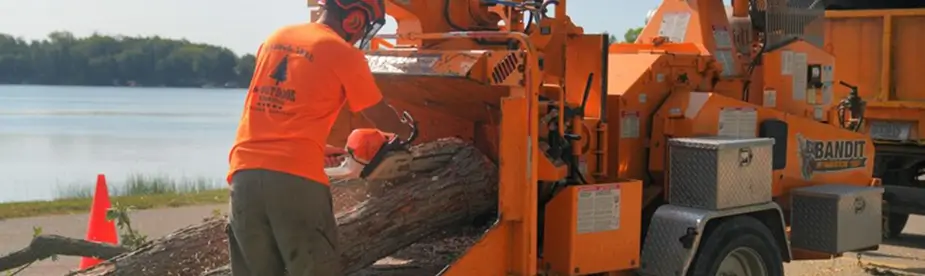
The night a tree comes down on your property in Burlington or anywhere across Southeast Wisconsin, most homeowners do the same three things in the wrong order. They run outside to look. They start moving smaller branches. They call around for prices before they’ve even checked whether the tree is safe to approach. None of that helps, and one of those choices can hurt you.
Fallen tree removal in Burlington and across Southeast Wisconsin is a specific job with real risks, and the right first steps protect you before anyone touches a chainsaw. Whether a tree came down in a summer thunderstorm, under heavy snow load, or after a saturated spring stretch loosened its roots, the priorities are the same. Here’s what to actually do, what affects the job, and what separates a clean professional removal from a dangerous one.
In This Article:
- The First 30 Minutes After a Tree Comes Down
- Power Lines and Trees: The Rule That Saves Lives
- What Affects the Cost and Complexity of Fallen Tree Removal
- Why Southeast Wisconsin’s Climate Drives So Many Calls
- Insurance: What You Should Document Before Cleanup Starts
- Why DIY Fallen Tree Removal Is the Wrong Call
- Frequently Asked Questions
- When to Call for Emergency Tree Service
The First 30 Minutes After a Tree Comes Down
Before anything else, slow down and look from a distance. Most of the worst injuries from fallen trees happen in the first few minutes when people rush in to assess damage.
Stay back and check three things, in this order:
- Power lines: Look for any wires touching the tree, lying on or near it, or sagging. If you see any, treat the area as live and unsafe until the utility confirms otherwise.
- People and pets: Account for everyone before walking around the debris.
- The structure of what remains: A tree that fell partway often has limbs still under tension, a hung-up trunk, or a remaining stump that’s split and unstable. Those are not stable just because the worst seems over.
Only after that, and only if nothing is touching wires, is it safe to step closer to look at the property damage. A fallen tree on a house, shed, fence, or car looks like a single problem but is usually two: the tree itself and the structural damage underneath that the tree is still pressing on. Both need to be handled, and they often need to be handled in a specific order to avoid making the damage worse.
Power Lines and Trees: The Rule That Saves Lives
This is the section that matters most, so it gets its own space.
If a fallen tree is touching, near, or tangled with any wire, including ones that look like cable or phone lines, stay back and call for help. According to local utility safety standards and federal emergency protocols outlined in the OSHA tree trimming and removal safety guidelines, all downed power lines must be assumed energized, meaning you must keep a safe distance of at least 30 feet.
What to do, in order:
- Stay at least 30 feet away from any tree touching a wire, and keep kids and pets clear.
- Call 911 and your utility provider (We Energies for most of Southeast Wisconsin) immediately.
- Don’t try to move anything with a stick, branch, or tool.
- Wait for confirmation that the line is de-energized before any tree crew, including a professional one, touches the tree.
A fallen tree near a power line isn’t a removal job until the utility makes it one. Any tree service that tries to start before that is taking a risk they shouldn’t, and you should consider it a sign to call someone else.
What Affects the Cost and Complexity of Fallen Tree Removal
Homeowners always want a number up front, which is fair, but fallen tree jobs vary more than standing tree removals because the situation drives the work. A few real factors move the price and the timeline:
- Where the tree fell: A trunk lying clean across an open lawn is a fast job. A tree on a roof, fence, deck, or car is slower and requires controlled cutting and rigging to avoid further damage.
- Whether power lines are involved: Even after de-energizing, work near utility easements is more careful and time-intensive.
- Tree size and species: A 60-foot oak trunk is a different job from a fallen ornamental. Oak, hard maple, and other dense hardwoods weigh more and cut slower.
- Whether the tree is fully down or partially fallen: A partially fallen tree, hung up in other trees or against a structure, has stored tension and is more dangerous and complex to take apart than one fully on the ground.
- Access: A backyard removal that requires hauling debris through a side gate takes longer than a front yard with truck access. In rural Walworth and Racine County properties, soft soil and tight driveways add their own complications.
- Whether specialized equipment is needed: Trees on structures often require crane-assisted removal or a spider lift to control the pieces. That equipment costs more to deploy but prevents the kind of secondary damage that turns a tree problem into a roof problem.
- Cleanup scope: Some homeowners want the property cleared down to bare ground. Others want logs kept for firewood. Both are fine, but they’re different jobs.
The honest framing: a reputable company won’t quote a fallen tree removal sight unseen for anything beyond the simplest situation. If someone gives you a hard number over the phone without seeing it, that’s usually a sign to keep calling.
Why Southeast Wisconsin’s Climate Drives So Many Calls
Our weather around Burlington, Lake Geneva, Mukwonago, and the rest of the region is hard on trees in a few specific ways, and understanding the pattern helps you anticipate which trees in your yard are most likely to fail next.
- Heavy wet snow and ice loading: Winter storms add enormous weight to limbs, and the most damaging events are usually wet, sticky snow followed by a freeze. Older hardwoods and trees with weak branch unions tend to fail under this load.
- Freeze-thaw cycles: Our late-winter and early-spring soil moves, and roots loosen along with it. A tree that stood through January wind can come down in March on a calmer day because the ground around it has shifted.
- Saturated spring soil: Heavy rain after the ground has thawed creates the conditions for whole-tree uprooting. The tree didn’t change; the ground did. The University of Wisconsin Extension’s forestry and tree care resources document this pattern well for Wisconsin landowners.
- Summer thunderstorms: Strong straight-line winds across open landscapes in southern Wisconsin take down otherwise healthy trees when a weak union or hidden decay finally gives.
- Aging tree population: A lot of properties in this part of the state have mature hardwoods that are at the back end of their useful structural life. The next storm finds them.
This is why Southeast Wisconsin sees concentrated waves of fallen tree calls after specific weather events, and why a smart homeowner uses calm periods to have weakening trees assessed before they become emergency removals.
Insurance: What You Should Document Before Cleanup Starts
This is the step people skip when adrenaline is high. Before any cleanup begins on significant damage, document everything.
Homeowner insurance often covers tree removal when a tree has damaged a covered structure, though specifics vary by policy. To protect a potential claim:
- Photograph everything before anything moves, including wide shots of the scene, close-ups of the damage to any structure, and the full extent of the tree.
- Don’t fully clear the site until the insurer or adjuster has the documentation, or you’ve at least photographed comprehensively.
- Save receipts for any emergency work or temporary repairs like tarping.
- Get a written assessment from a licensed, insured tree service describing the damage and the work performed.
A properly insured tree service can provide the kind of documentation insurers ask for. That’s part of why working with a licensed and insured company on a fallen tree job protects you twice: once during the work, and again during the claim.
Why DIY Fallen Tree Removal Is the Wrong Call
Most fallen tree work is not a chainsaw-and-a-Saturday project, and the reasons go beyond inexperience.
A tree on the ground is rarely as relaxed as it looks. Branches are pinned under the weight of the trunk, the trunk itself is often bowed and storing massive kinetic energy, and a wrong cut can release that energy in a split second. Because of these severe tension hazards, the Wisconsin Department of Natural Resources storm recovery resources advise property owners to avoid felling or bucking storm-damaged trees unless they are highly experienced.
Then there’s everything around the tree. A fallen tree on a roof can’t be cut from the top down without controlling the pieces, or each section drops and breaks more of the roof. A tree on a fence needs careful sectioning so the fence isn’t dragged with it. Anything near a power line is off-limits regardless of skill level.
A few specific situations homeowners try and shouldn’t:
- A partially fallen tree hung up in another tree. This is one of the most dangerous scenarios in tree work and requires specialized rigging.
- A tree on or near a structure. Removing it without controlled cutting and lifting almost always causes additional damage.
- Trees on or near power lines. Not a DIY situation, ever.
- Large trunks blocking driveways or roads. Bigger than they look, heavier than they look, and rolling unpredictably when cut.
A clean chainsaw-and-pickup job applies to small downed limbs in open spaces, and that’s about it.
For situations involving structures or wires, knowing the emergency tree removal process ahead of time, including who to call and what to expect, takes a lot of stress out of the moment. For weakened standing trees you’d rather not see become emergencies, a quick hazard inspection flags the ones that need attention before the next storm finds them.
Frequently Asked Questions
What should I do first when a tree falls on my property in Burlington?
Stay back and check for power lines before anything else. If any wire is involved, call 911 and your utility, stay 30 feet away, and wait for the line to be confirmed de-energized. Once that’s clear, document the damage with photos before any cleanup begins.
Will my insurance cover fallen tree removal?
Often, yes, especially when the tree has damaged a covered structure like a house, garage, or fence. Coverage varies by policy and circumstance. Document everything before cleanup, save receipts, and confirm the specifics with your insurer. A licensed and insured tree service can provide written assessments that support a claim.
How quickly can a fallen tree be removed?
For straightforward jobs, often the same or next day. Emergencies involving structures, wires, or after a major storm depend on demand and complexity. A 24/7 emergency tree removal team can usually respond fast to stabilize a hazardous situation even when full cleanup takes longer.
Can I cut up a fallen tree myself?
Small branches on the ground, away from wires and structures, are usually safe to handle with care. Anything under tension, partially fallen, on a structure, or near a power line should be left to professionals. Most serious chainsaw injuries happen when cutting limbs that are pinned or storing tension.
Why are professional removals more expensive than they look?
A fallen tree job often involves crane-assisted lifting or rigging to prevent further damage to structures, careful sectioning to manage tension, insurance and licensing overhead, and full debris removal. The price reflects what it actually takes to do the job safely, not just the tree itself.
Do I need a permit to remove a fallen tree?
Generally, no for emergency removals on private property. Some Burlington-area municipalities have rules around large trees in conservation zones or near rights-of-way, and removal near utilities involves coordination, but routine fallen tree removal on a residential property typically does not require a permit.
When to Call for Emergency Tree Service
The straightforward rule: if a tree is on a structure, blocking a driveway or road, near a wire, partially fallen, or anywhere near people who use the space daily, that’s an emergency call. Waiting through one more storm with that situation in place is taking the kind of risk most homeowners later wish they hadn’t.
If you’ve had a tree come down on your property anywhere around Burlington, Lake Geneva, Mukwonago, Muskego, or anywhere across Southeast Wisconsin, the safe move is to secure the area, document the damage, and bring in a crew that handles this work after every major storm. The team at Rausch Tree and Outdoor Services is veteran-owned, fully licensed and insured, equipped with cranes and spider lifts for the trickier removals, and available 24/7 for emergencies. A quick assessment will tell you what needs to come down first, how to protect any structure underneath, and what to expect from start to clean.