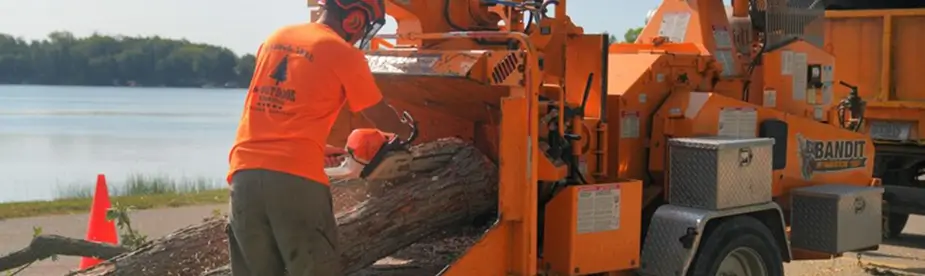
If you have a large tree in Burlington that worries you, this guide explains what actually goes into removing it safely, what it costs, when a permit comes into play, and how to tell the difference between a tree that can wait and one that cannot. The goal is to help you make a smart decision before anything is cut.
What Counts as a “Large” Tree Removal
Size alone is not the whole story. A removal becomes “large” or “complex” when the tree’s height, trunk diameter, weight, or location raises the stakes.
In and around Burlington, the trees that usually fall into this category include:
- Mature oaks, which can reach 60 to 80 feet, with very heavy, dense wood
- Silver and sugar maples that spread wide canopies over roofs and driveways
- Old ash trees killed by the Emerald Ash Borer, which become brittle and unpredictable
- Tall white pine and spruce planted decades ago as windbreaks on rural lots
A tree growing in an open field is one kind of project. The same tree growing three feet from your foundation, over a power line, or between two houses is a different one. The closer a heavy tree is to something you care about, the more planning and equipment the removal requires.
What Makes Large Tree Removal Different?
With a small tree, a crew can often fell it in one piece and clean up. Large trees rarely allow that. The wood is too heavy, and the surroundings are too tight to simply drop it and hope.
Instead, large removals are usually done in controlled sections from the top down. A climber or a lift operator removes limbs and trunk pieces one at a time, lowering each piece with ropes or setting it down with a crane. Done right, the tree comes apart in a planned sequence so nothing falls where it shouldn’t.
This is where specialized equipment matters. A crane can lift a multi-thousand-pound trunk section straight up and over a house rather than dropping it. A spider lift reaches high into a canopy from a compact base, so crews can work over a fence or a flower bed without tearing up the lawn. Rigging systems let a crew lower branches in a slow, controlled way instead of letting gravity do the work. None of this is for show. It is how a heavy tree gets removed without cracking a roof, a deck, or a gas line.
Burlington’s Climate Makes Large Trees Riskier Than People Expect
Southeast Wisconsin is hard on trees, and the bigger the tree, the more those stresses add up.
Heavy winter snow and ice load down limbs that are already long and heavy on a mature tree. Freeze-thaw cycles in late winter loosen the soil around roots. Then spring brings saturated ground from rain and snowmelt, which weakens a tree’s grip in the soil right as the first strong storms roll through. A large tree with a wide canopy catches more wind, so the same gust that barely moves a young tree can lever an old one over at the roots.
The National Weather Service office in Sullivan tracks the severe storms that move through Racine and Walworth Counties each year, and high winds are a regular feature of our spring and summer. A leaning or decayed large tree that survives one season may not survive the next.
Pests make this worse. The Wisconsin DNR has documented the Emerald Ash Borer across the state, and it has killed large numbers of ash trees in our area. A dead ash does not stay standing safely for long. The wood becomes brittle, branches drop without warning, and the whole tree can fail in a storm. Many of the large removals we see locally are ash trees that have already died standing.
What We Commonly See In The Field
After years of removing large trees around Burlington and the surrounding lake communities, a few patterns repeat over and over.
Dead ash trees are the most common large removal we handle. Homeowners often wait, hoping the tree will leaf out again. It won’t. Once an ash is dead, every season it stands makes it more dangerous to climb and more likely to come apart on its own.
Oaks near houses are the most underestimated. Oak wood is extremely heavy, and a single large limb over a roof can weigh more than a small car. People look at a big oak and see shade. We look at it and calculate where the weight goes if a limb fails.
Leaning trees after wet springs are a frequent emergency call. When the soil stays saturated and a strong storm hits, large trees with shallow or damaged roots tip without breaking. By the time you see the lean, the roots have usually already let go on one side.
Trees planted too close to homes decades ago are a recurring problem on older Burlington lots. A sapling planted six feet from the house in 1985 is now a massive tree pressing against the siding and roof. These removals are almost always tight, technical jobs.
Do You Need a Permit to Remove a Large Tree in Burlington?
Sometimes, and it depends on the tree and where it sits. Rules in Wisconsin are local, not statewide, so the answer changes from one property to the next.
Some municipalities in Racine and Walworth Counties require approval before removing large trees near property lines, roadways, wetlands, or conservation areas. Protected or heritage trees may also need sign-off. If your removal is tied to construction or land clearing, that can trigger separate requirements.
The simplest way to confirm is to check with the City of Burlington Planning and Zoning Department before work begins, or ask your tree service to confirm for you. A reputable company will not skip this step, because removing a protected tree without approval can put the cost on you.
Trees near power lines are a separate category. Work close to utility lines has to be coordinated with the utility provider, both for safety and because untrained removal near energized lines is genuinely dangerous. This is not a place to improvise.
What a Large Tree Removal Typically Costs
There is no flat price, and any company that quotes one over the phone without seeing the tree is guessing. Cost depends on real factors:
- Size and species. A tall oak with dense wood takes longer and is heavier to handle than a pine of the same height.
- Location and access. A tree in an open backyard with a clear path costs less than one wedged between a house and a fence.
- Proximity to structures. The closer the tree is to a building, power line, or pool, the more rigging and equipment the job needs.
- Equipment required. Jobs that need a crane or a spider lift cost more than ones a crew can handle from the ground, but that equipment is often what makes the removal safe in the first place.
- Cleanup and stump. Hauling away the wood and grinding the stump are usually priced as part of the job or as add-ons.
A written estimate after an in-person assessment is the only number you should trust. It should spell out exactly what is and is not included, so there are no surprises on the day of the work.
What Homeowners Can Do Now
You don’t need to be an arborist to spot a large tree that deserves a closer look. Walk your property and check for:
- Dead branches in the upper canopy, or no leaves on part of the tree during the growing season
- Cracks or splits in the trunk or where large limbs attach
- A new or worsening lean, especially after a storm
- Mushrooms or fungus growing at the base, which can signal internal decay
- Soil heaving or lifting on one side of the trunk
- Bare patches under the bark or D-shaped exit holes on ash trees are a sign of the Emerald Ash Borer
If you notice any of these on a large tree near your home, get it inspected. The University of Wisconsin Extension forestry program offers solid background reading on tree health if you want to understand what you are seeing.
What Not to Do
Do not try to take down a large tree yourself. This is the advice that gets ignored most often, and it is the one that matters most.
Large tree removal sends people to the emergency room every year. Chainsaw injuries, falls from ladders, and being struck by limbs or trunk sections that move in ways homeowners don’t expect are all common. A trunk section that looks manageable can weigh hundreds of pounds and pin a leg in a second. A tree under tension can snap back when cut. Branches near power lines can kill.
Renting equipment does not solve this. The skill is in reading the tree, knowing where the weight is, and cutting in the right sequence. That comes from training and experience, not from a rental yard.
When Professional Help Is Necessary
Bring in a professional any time a large tree is dead, decayed, leaning, or close to anything you’d be upset to lose. Call sooner rather than later if a tree has already failed or partly failed in a storm, if a limb is hanging, or if a tree is touching a power line.
A qualified tree service should be licensed, bonded, and insured, including workers’ compensation coverage. That insurance protects you, not just the crew, if something goes wrong on your property. Look for credentials like ISA membership, which points to training in current tree care standards.
Frequently Asked Questions
How Do I Know If My Large Tree Needs to Come Down or Can Be Saved?
It depends on the tree’s overall health, the location of any damage, and the risk it poses. A tree with a few dead branches may only need pruning, while a tree with a major trunk crack, advanced decay, significant root damage, or a new lean often requires removal. A professional inspection is the most reliable way to determine whether a tree can be safely preserved.
Can a Large Tree Be Removed Without Damaging My Lawn or Landscaping?
In many cases, yes. Equipment such as spider lifts and cranes allows crews to remove large trees with minimal impact on lawns, gardens, and hardscapes. An experienced tree service will also plan access routes and cleanup procedures to help protect the surrounding property.
Will My Homeowner’s Insurance Cover Large Tree Removal?
Sometimes. Homeowner’s insurance may cover tree removal when a tree falls on a home, garage, fence, or other insured structure, particularly after a storm. Coverage is less common for the preventative removal of healthy or unwanted trees. Keeping photos, written estimates, and damage documentation can help support a claim.
How Long Does It Take to Remove a Large Tree?
Most large tree removals can be completed in a single day. However, very large trees or those located near homes, power lines, fences, or other structures may require additional equipment and time. A site inspection will provide the most accurate timeline.
What Happens to the Stump After Tree Removal?
The stump can be ground below ground level using specialized equipment. Stump grinding helps prevent regrowth, removes a tripping hazard, and prepares the area for grass, landscaping, or future planting. Many homeowners choose to include stump grinding as part of the removal project.
Can a Large Tree Be Saved Instead of Removed?
Sometimes. Trees with minor damage, isolated dead branches, or manageable structural issues may be candidates for pruning, cabling, bracing, or other corrective treatments. Trees with severe decay, major trunk failures, extensive root damage, or significant safety risks are more likely to require removal. A professional evaluation is the best way to determine the right solution.
Get a Straight Answer About Your Tree
If you have a large tree near your home in Burlington or anywhere in Southeast Wisconsin and you’re not sure whether it’s a problem, the safest move is to have it looked at before a storm decides for you.
Rausch Tree and Outdoor Services is a veteran-owned, family-operated tree service company based right here in Burlington, with the crane, spider lift, and rigging equipment that large removals call for. We provide free, written estimates and honest recommendations, so you’ll know exactly what your tree needs and what it will cost before any work begins.
Call (262) 800-4471 or request a free estimate to schedule a tree inspection.