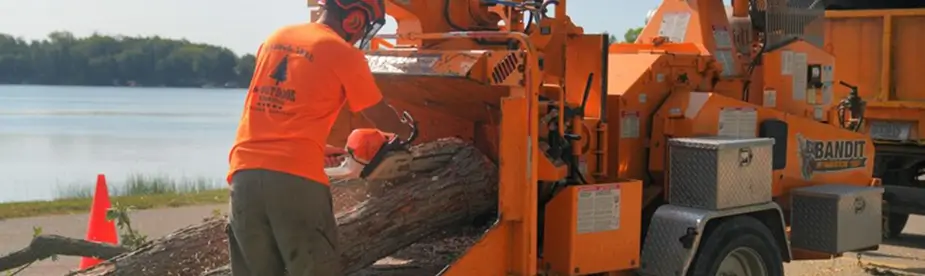
Professional cleanup matters after an emergency tree removal because taking the failed tree off your house, car, or driveway does not automatically mean your property is safe or fully restored. Removal solves the immediate hazard. Cleanup addresses everything that hazard left behind, and those are two different stages of the same job.
We see this gap a lot after a storm. A homeowner is relieved the tree is off the roof and the driveway is clear, and understandably stops thinking about the property at that point. But logs, buried debris, hanging limbs on nearby trees, and disturbed ground can all still be there, and some of those things are more dangerous than the tree that just came down.
What Can Remain After the Main Tree Is Removed?
Several things can still be on your property even after the tree itself is gone, and what remains depends on the size of the tree and how it failed. Common leftovers include:
- Logs and heavy trunk sections that need to be moved or hauled away
- Branches and brush scattered across the yard
- Sawdust and wood chips left from cutting
- Broken or hanging limbs still caught in the canopy of the tree that failed or in nearby trees
- A stump and roots left at or below ground level
- Holes, ruts, or disturbed soil where the tree fell or equipment worked
- Damaged fencing, siding, or landscaping near the impact area
- Small wood fragments and splinters hidden in the grass
- Damage to neighboring trees that were struck as the original tree came down
Not every removal leaves behind all of these. A smaller tree taken down cleanly might leave little more than some brush and a stump, while a large tree that split apart in a storm can leave a much wider mess spread across the property.
Why Is Storm Debris Dangerous to Handle?
Storm debris is dangerous because tree material after a failure often behaves unpredictably, even when it looks stable sitting on the ground. A trunk section under tension, a branch bent and loaded by the weight of other debris, or a root plate partially pulled from the ground can shift or release suddenly when disturbed.
An uprooted tree with the root plate still partially in the ground is a particular concern, since the tree can settle further or tip once the weight distribution changes. Limbs left hanging in a damaged canopy, sometimes called widow-makers, can fall without warning long after the initial storm has passed. If any part of the debris is near a downed or damaged utility line, that adds an entirely separate hazard that should never be approached without the utility company involved. None of this is something to work through with a chainsaw and a rope on your own, particularly when material is under load or twisted from the way it fell.
How Does Professional Equipment Improve Cleanup?
Professional equipment improves cleanup by giving a crew control over how debris moves, rather than relying on gravity and guesswork. Rigging systems allow branches and trunk sections to be lowered in a planned direction instead of dropped. A chipper processes brush efficiently rather than leaving it to pile up. A crane can lift and place large sections without dragging them across the property, and a stump grinder handles the remaining stump in a controlled, below-grade cut. The USDA Forest Service’s tree risk and removal resources provide additional information on professional approaches to managing trees safely.
Equipment reduces risk and improves control, but it does not eliminate every possibility of damage or guarantee a specific outcome on every property. What it does is give the crew more precise options than hand tools alone would allow, which matters most when a large tree has come down close to a structure.
Can Cleanup Help Prevent Additional Property Damage?
Yes, thoughtful cleanup can reduce additional damage to your property, though it cannot eliminate every risk of some disturbance during the work. Dragging a heavy trunk section across a lawn can tear up turf. Rolling logs without a plan can crack pavement or damage a fence. Dropping debris without considering its path can strike siding, a parked vehicle, or landscaping that survived the original failure.
Planning equipment access routes, choosing where to stage cut material, and thinking through how each piece will move before cutting it all help limit unnecessary damage. Some disturbance to lawn or soil is often unavoidable when heavy equipment has to operate in a tight yard, especially on wet ground, but a deliberate approach keeps that disturbance to what is actually necessary rather than adding damage the removal itself did not require. The International Society of Arboriculture’s tree care safety resources also explain why proper equipment, planning, and qualified tree care practices matter during tree work.

What Does Professional Tree Cleanup Usually Include?
What is included in cleanup depends entirely on the written estimate and the specific condition of your property, so it is worth confirming rather than assuming. Depending on the scope agreed to, cleanup work may include cutting large material into manageable sections, chipping brush, moving or hauling away logs, collecting smaller debris and fragments, clearing driveways and walkways for access, raking or sweeping the immediate work zone, discussing whether stump grinding is part of the job, and inspecting the site for any remaining tree hazards.
Not every job includes every item on that list. A cleanup focused narrowly on clearing a driveway is a different scope than a full property restoration after a large tree came down across the yard, and the written estimate should spell out which of these applies to your situation.
What Happens to the Logs, Branches, and Wood Chips?
What happens to debris after cleanup depends on the material, the contractor, and what you agree to beforehand, since there is no single standard practice across every job. Logs and larger sections may be hauled away, cut to length and left for firewood if you want to keep them, or in some cases repurposed depending on the wood and the arrangement. Branches typically go through a chipper, and the resulting wood chips can be hauled off or left on the property as mulch if that works for your landscaping.
Confirm what you want to happen with each type of material before the crew starts. Do not assume that every piece of wood will automatically be hauled away at no additional cost or that every option, like recycling or firewood, is included by default.
Does the Stump Need to Be Removed After an Emergency?
Not necessarily, since stump removal after an emergency is usually a separate decision from the removal itself. Whether it makes sense to grind the stump right away depends on where it sits, whether it creates a tripping hazard, what you plan to do with the area afterward, how much equipment access the location allows, and whether the species is prone to sending up new growth from the remaining roots.
Some property owners want the stump handled the same day as part of a complete cleanup, while others are fine leaving it for a later visit once other priorities are addressed. Our stump grinding page covers what that process generally involves if you decide to move forward with it.
Should Nearby Trees Be Inspected After the Storm?
Yes, other trees on your property that were exposed to the same storm may have damage even if they are still standing and look fine at first glance. The wind, saturated soil, ice, or lightning that brought one tree down can weaken or injure others nearby without causing an immediate, obvious failure.
Warning signs worth watching for on surrounding trees include a new or worsening lean, soil that has lifted or cracked near the base, cracks running through the trunk, branches that are hanging or broken but still attached, and any split in a major stem. None of these signs alone confirms exactly how serious the damage is, which is part of why a visible symptom on a nearby tree is worth a professional look rather than a guess based on appearance. Our structural tree hazard guide walks through some of these warning signs in more depth, and our tree risk assessment service can evaluate a specific tree you are concerned about.
What Should Property Owners Document Before Cleanup?
Documenting the scene before debris is moved can be genuinely useful if property damage occurred or you plan to file an insurance claim, but only when it is safe to do so. Photos and video of the tree, the damage to structures or vehicles, and the surrounding area give your insurance provider a clearer picture than a description alone.
If it is not safe to get close, whether because of hanging limbs, damaged power lines, or an unstable root plate, do not risk approaching for a photo. Once documentation is handled safely, contact your insurance provider to discuss the situation, and keep any written estimates and receipts related to the removal and cleanup. We cannot promise what your specific policy will or will not cover, since that depends entirely on your coverage and provider, but having thorough documentation puts you in a stronger position either way.
What Should You Ask Before Hiring a Cleanup Provider?
A few direct questions upfront can prevent confusion about scope once the work is underway. Before hiring a provider for post-removal cleanup, it helps to ask:
- Is debris hauling included in the estimate, or billed separately?
- What materials will actually be removed, and what will be left behind?
- Is stump grinding included in this visit, or quoted as a separate service?
- How will equipment access the work area, and what path will it take?
- How will nearby structures, fencing, and landscaping be protected or accounted for?
- Will surrounding trees be checked for obvious storm damage as part of the visit?
- What documentation, such as before-and-after photos, will be provided?
- What condition should the property reasonably be in once the work is finished?
Getting clear answers before the crew arrives avoids surprises about what does and does not happen that day.
What Affects the Cost of Post-Removal Cleanup?
Cost depends on the specific conditions of your cleanup rather than one flat rate, since a small brush pile and a full property covered in storm debris are entirely different jobs. Factors that typically influence pricing include the total amount and weight of debris, the size and species of the tree involved, how accessible the site is for equipment, proximity to buildings or utility lines that requires extra caution, whether specialized equipment like a crane is needed, hauling and disposal requirements, whether stump grinding is part of the scope, any ground or landscape restoration needed afterward, and how urgent the situation is given remaining hazards.
Because these factors vary so much from one property to the next, an accurate number comes from seeing the actual site rather than a description over the phone.
When Is Cleanup an Emergency?
Cleanup becomes urgent when a hazard is actively blocking access or putting people or property at immediate risk, rather than simply being unsightly. Situations that call for immediate attention include debris blocking a driveway or path needed for emergency access, unstable material resting against or on top of a structure, damaged utility lines near the debris, hanging limbs positioned over an area people or vehicles regularly use, or a tree that remains partially uprooted and could shift further.
Debris that is simply scattered across an open lawn with no immediate access or safety concern can typically wait for a scheduled visit rather than requiring an emergency response. If you see a downed or damaged power line anywhere near the debris, stay well away from it and contact your utility company or local emergency services immediately. Never attempt to move material that could be in contact with an energized line.
What Should the Property Look Like After Cleanup?
What your property should look like afterward depends entirely on what was agreed to in writing, so it helps to set that expectation before work begins rather than after. A professional cleanup should address the debris included in the scope and leave the immediate work zone reasonably safe and accessible.
Some things are commonly treated as separate services rather than automatic parts of cleanup. Lawn repair, grading, stump grinding, replacing damaged soil, and rebuilding a fence or other structure often fall outside a standard debris cleanup unless specifically included in your estimate. Confirming this ahead of time means you know what to expect when the crew leaves, rather than assuming a task was covered when it was not.
Request Professional Post-Storm Cleanup
If a tree has come down on your property and you are dealing with more than just the obvious hazard, we can help sort out what needs immediate attention and what can be scheduled. We work with homeowners and businesses throughout Burlington and Southeast Wisconsin on emergency tree removal, the debris cleanup that follows, and a look at any other trees that took a hit during the same storm.
Reach out through our contact page or request a free estimate, and we will walk the property with you to figure out exactly what the cleanup should include before any work begins.