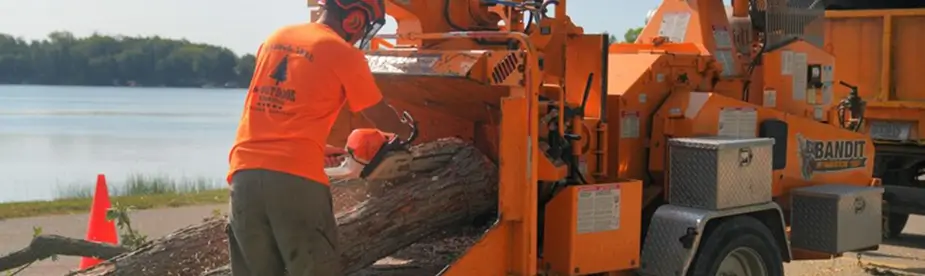
If a storm-damaged tree is blocking your driveway, keep people, pets, and vehicles away while you check for power lines and unstable tree sections from a safe location. Do not begin cutting, pulling, or moving the tree until electrical and structural hazards have been ruled out.
A blocked driveway can feel urgent, especially when it is the only way to enter or leave the property. However, fallen trees may contain tension-loaded wood, suspended branches, shifting root plates, and other hazards that are difficult to recognize from the ground.
At Rausch Tree and Outdoor Services, we help property owners throughout Southeast Wisconsin respond to fallen trees and storm-related access problems. The correct response depends on the tree’s position, surrounding hazards, property damage, and whether emergency access is affected.
What Should You Do First When a Tree Blocks Your Driveway?
Your first step is to keep everyone away and evaluate the scene without approaching the tree. Restoring access can wait until you know the area is free from electrical hazards and unstable wood.
Follow these initial steps in order:
- Keep people, pets, and vehicles out of the affected area.
- Look for fallen or low-hanging utility lines from a safe location.
- Check for hanging branches, split trunks, lifted roots, and leaning nearby trees.
- Call 911 if there is an immediate threat to life, fire, or urgent medical need.
- Contact the utility provider if a tree or branch is touching a power line.
- Photograph the scene from a safe position when doing so will not delay emergency action.
- Contact a professional tree service if the tree cannot be moved safely.
Do not walk beneath the damaged canopy to inspect the trunk or branches. Storm-damaged trees can continue shifting after the wind stops, particularly when the soil is saturated or the tree is resting against another object.
When Should You Stay Away From the Fallen Tree?
Stay away whenever the tree may be energized, unstable, suspended, or under tension. These conditions can cause sections of the tree to move suddenly even when the trunk appears to be resting securely.
Warning signs include downed utility lines, branches hanging overhead, a split trunk, an exposed or lifted root plate, fresh soil movement, and a nearby tree leaning toward the driveway. A trunk resting on a fence, building, vehicle, or another tree may also shift when weight is removed.
Bent branches and partially broken trunks can store considerable force. Cutting one section may cause another section to spring, roll, drop, or rotate. A root plate may also settle back toward the ground after trunk weight is removed.
Our guide to structural tree hazards explains several warning signs that may indicate a tree needs professional attention. However, a storm-damaged tree cannot be fully assessed from one visible defect or a photograph alone.
If the tree has damaged an exterior wall, roof, gas line, or electrical connection, remain in a protected location when possible and follow instructions from emergency responders or the appropriate utility. Do not enter a visibly damaged part of a building simply to inspect the tree.
What Should You Do if Power Lines Are Involved?
Assume every fallen, sagging, or low-hanging electrical line is energized. Stay away from the line and anything it touches, including the tree, nearby fences, vehicles, puddles, and wet ground.
Do not attempt to determine whether the line is active. Power can sometimes be restored automatically, and utility equipment may energize objects that appear disconnected.
Contact the utility provider responsible for the line. We Energies emergency guidance directs customers to report downed power lines and provides a separate contact for trees touching power lines. If another utility serves your property, use that provider’s emergency number.
Call 911 when a line is sparking, a fire has started, someone has been injured, or another immediate threat to life is present. Keep others away while waiting for trained responders.
Tree work should not begin near an energized line until the utility has evaluated the situation and made the area safe. A homeowner or ordinary tree service should never touch the line or cut a tree that is contacting it without proper utility coordination.
What if the Driveway Is Your Only Exit?
A blocked driveway becomes more urgent when residents cannot leave or emergency vehicles cannot reach the home. Tell the tree service and emergency dispatcher that the driveway is the property’s only usable access point.
Call 911 if someone needs immediate medical assistance, a fire or gas emergency is occurring, or the blocked driveway creates another active threat. Police, fire, medical, utility, or public works personnel may need to address part of the situation before tree removal can begin.
If there is no active emergency, remain in a safe area and explain the access problem when requesting professional help. Do not attempt to drive around, beneath, or through a fallen tree unless the route has been confirmed clear and safe by the appropriate professionals.
A tree company does not replace emergency services or the utility provider. Our role begins with evaluating and removing the tree once the work area can be entered safely.
Can You Cut or Move the Tree Yourself?
Homeowners should not use chainsaws, ladders, ropes, winches, tractors, or vehicles to move a large storm-fallen tree. The visible obstruction may be only one part of a larger, unstable system.
Major hazards include tension-loaded trunks, rolling logs, suspended limbs, unstable nearby trees, and root plates that may settle when the trunk is cut. A tree resting against a building or vehicle can also transfer its weight unexpectedly as sections are removed.
Pulling the tree with a truck or tractor may cause the trunk to roll toward the operator or damage the vehicle. Ropes and winches can fail or release suddenly. Using a ladder near broken branches places the user directly within the potential fall zone.
The Wisconsin Department of Natural Resources advises people without chainsaw experience not to fell storm-damaged trees themselves. Professional assistance is especially important when branches are overhead, the trunk is under tension, utilities are nearby, or the tree rests against a structure.
Small, loose debris may be moved only after the surrounding area has been confirmed safe. Do not use the presence of a few movable branches as evidence that the entire fallen tree is stable.
What Storm Damage Should You Photograph?
Photograph the overall scene, the blocked driveway, and visible property damage from outside the hazard area. Documentation can help the tree service understand the situation and may support an insurance claim.
When it is safe, useful photographs may include:
- The full tree and its position across the driveway
- The driveway blockage from more than one angle
- Damage to vehicles, buildings, pavement, fences, or gates
- The trunk, broken branches, and exposed root plate from a distance
- Any utility line involvement without approaching the line
- Other storm damage surrounding the tree
- Time-stamped images taken before major cleanup begins
Do not move branches or enter an unstable area to obtain a clearer photograph. Remote images can help with an initial review, but they cannot replace an on-site assessment when structural conditions are uncertain.
Emergency action should not be delayed solely to take pictures. If someone is injured, a power line is down, or the tree is continuing to move, contact the appropriate emergency service first.
Should You Contact Your Insurance Company Before Removing the Tree?
Contact your insurance provider as soon as practical, but do not delay necessary safety work while waiting for an adjuster. Coverage depends on the policy, cause of the fall, reason for removal, and whether insured property was damaged.
Tell the insurer that the tree is blocking access and describe any damage to the home, garage, fence, vehicle, or other covered property. Ask what documentation the insurer needs and whether you should retain invoices, estimates, photographs, or removed materials.
Emergency work may need to begin before an adjuster arrives when the tree threatens people, property, utilities, or essential access. Keep records of the condition before cleanup when photographs can be taken safely.
A tree that only blocks a driveway may be handled differently from one that damages a covered structure. Neither a tree service nor a general article can confirm what a particular policy will pay. Your insurer must interpret the policy and claim circumstances.
Who Is Responsible if the Tree Came From Another Property?
Responsibility depends on property ownership, prior knowledge of the tree’s condition, possible negligence, local rules, and the insurance policies involved. Do not assume that the tree’s original location automatically determines who must pay.
Document the tree’s position, the apparent property line, and all resulting damage from a safe location. Notify the neighboring property owner, landlord, business, municipality, homeowners association, or other responsible authority when applicable.
Contact your insurance provider even if the tree originated elsewhere. The insurer can explain how to submit the claim and what additional information may be required.
Property-line and liability disputes can involve legal questions that vary by situation. A tree service can document conditions and perform authorized work, but it cannot make a binding determination about legal responsibility.
When Does a Blocked Driveway Require Emergency Tree Removal?
Emergency tree removal is appropriate when the tree blocks essential access and cannot be moved safely without specialized equipment or training. It may also be necessary when unstable branches, structural damage, utilities, or nearby buildings create an immediate hazard.
A tree across the only driveway can prevent residents from leaving and responders from entering. The situation becomes more urgent if someone on the property has a medical need or if there is no alternate route for emergency vehicles.
Professional help is also appropriate when the tree is suspended, resting on a structure, under tension, or connected to an unstable root plate. Our emergency tree removal service addresses fallen trees, blocked access, and storm-related hazards throughout the company’s verified service area.
When calling, explain whether utilities, vehicles, structures, or injuries are involved. Clear information helps determine which authority should respond first and what conditions the tree service may encounter.
Can the Tree Be Pruned Instead of Completely Removed?
Pruning may be possible if only part of the tree failed and the remaining roots, trunk, and canopy retain a viable structure. Complete removal may be necessary when the tree is uprooted, severely split, extensively decayed, or unable to stand with acceptable stability.
A large branch across the driveway does not always mean the whole tree must come down. The remaining tree should be inspected for cracks, torn attachments, canopy imbalance, root movement, and hidden decay before a recommendation is made.
Corrective tree trimming may remove damaged branches and restore clearance when the primary structure remains sound. More focused structural pruning may help manage weak or poorly positioned growth over time.
When the root plate has lifted or the main trunk has failed, pruning may not address the underlying instability. Our tree removal services provide more information about situations in which retaining a tree may no longer be practical.
No removal or pruning decision should be based on a photograph alone when significant structural damage is present. An on-site assessment allows the roots, trunk, canopy, surroundings, and potential consequences of failure to be considered together.
What Happens During Professional Driveway Clearing?
Professional driveway clearing begins with a hazard assessment and a plan for controlling the tree’s movement. The exact process depends on the tree’s size, position, condition, and surrounding hazards.
A typical response may involve:
- Completing a remote or on-site hazard assessment
- Establishing a safe work area around the tree
- Coordinating with the utility provider when required
- Stabilizing the trunk or damaged sections
- Cutting and removing sections in a controlled sequence
- Opening a usable route through the driveway
- Handling logs, branches, and other debris
- Checking nearby trees for visible storm damage
The initial goal may be to create safe access rather than finish every optional cleanup task immediately. Stump work, complete debris handling, or follow-up pruning may be scheduled based on site conditions and the approved scope.
Different jobs require different tools. Rausch Tree and Outdoor Services uses professional tree service equipment for controlled access, lifting, rigging, and debris handling when appropriate. Equipment selection still depends on available space, soil conditions, overhead obstacles, and the tree’s position.
What Affects the Cost of Removing a Tree From a Driveway?
The cost depends on the tree’s size, condition, location, and the complexity of moving it without causing additional damage. A tree lying flat in an open area may require a different approach than one suspended over vehicles or caught in utility lines.
Other factors include equipment requirements, site accessibility, time of service, debris volume, stump work, and required utility coordination. Saturated soil, narrow driveways, lake-area access, nearby buildings, and existing property damage can also affect planning.
The amount of work needed to open the driveway may differ from the work required for complete removal and cleanup. Ask for the scope to identify what is included, such as access clearing, hauling, stump grinding, or evaluation of nearby trees.
Insurance reimbursement should never be assumed. Retain the written estimate, invoice, photographs, and other documentation requested by your provider.
How Can You Reduce the Risk of Another Blocked Driveway?
Regular inspections and appropriate pruning can reduce some predictable tree hazards near driveways, but no service can prevent every storm-related failure. Severe thunderstorms, strong winds, ice, heavy snow, and saturated soil can affect even well-maintained trees.
Pay attention to dead branches, cracks, weak unions, decay, root disturbance, and newly developing leans near access routes. Trees should also be checked after major storms because new damage may not be obvious from inside the home.
Removing deadwood and reducing poorly distributed branch weight may lower the chance of certain failures. Pruning should preserve the tree’s natural structure rather than remove excessive live growth.
Consider how trees are positioned around the property’s only entrance. Rural homes, commercial properties, farms, and lake-area lots may benefit from reviewing alternate access and emergency contact plans in addition to tree maintenance.
Frequently Asked Questions
Who should I call when a tree blocks my driveway?
Call 911 if the blockage creates an immediate threat to life, fire response, or urgent medical access. Contact the utility provider for power-line involvement and a professional tree service for safe tree removal or access clearing.
Can I drive over small branches to leave my property?
Do not drive over branches until the route has been checked for hidden wires, sharp debris, unstable limbs, and trunk movement. A small visible branch may be connected to a larger section under tension.
Will homeowners insurance cover a tree blocking a driveway?
Coverage depends on your policy, why removal is necessary, and whether covered property was damaged. Contact your insurance provider and avoid assuming that driveway obstruction alone guarantees coverage.
Can a fallen tree be removed if it touches a power line?
Tree removal should not begin until the utility provider has evaluated the line and made the area safe. Stay away from the tree, assume the line is energized, and report the situation immediately.
How quickly can a blocked driveway be cleared?
Timing depends on weather, demand, utility involvement, site access, and the hazards surrounding the tree. No exact clearing time can be promised before the situation is assessed.
Does a storm-damaged tree always need complete removal?
No. A tree may be retained when the damage is limited and the remaining roots, trunk, and canopy are structurally viable. Uprooting, severe splitting, extensive decay, or major structural loss may make complete removal necessary.
Get Help With a Tree Blocking Your Driveway
If a fallen or storm-damaged tree is blocking access to your Southeast Wisconsin property, contact Rausch Tree and Outdoor Services for a professional assessment. We can evaluate the tree, surrounding hazards, and work required to restore usable access.
Use our request an estimate form for non-life-threatening service needs, or visit our contact page for current company information. Call emergency services or the appropriate utility first whenever injuries, fire, gas, or electrical lines are involved.